Skip to content
Fixed vs Ventilated Skylights: Which One Is Right for Your Home?
Skylights are a great way to bring natural light into spaces that may not get enough daylight through traditional windows. But once you’ve decided to install one, there is another important question to answer:
Should you choose a fixed skylight or a ventilated skylight?
Both options can bring more daylight into your home, but they serve slightly different purposes.
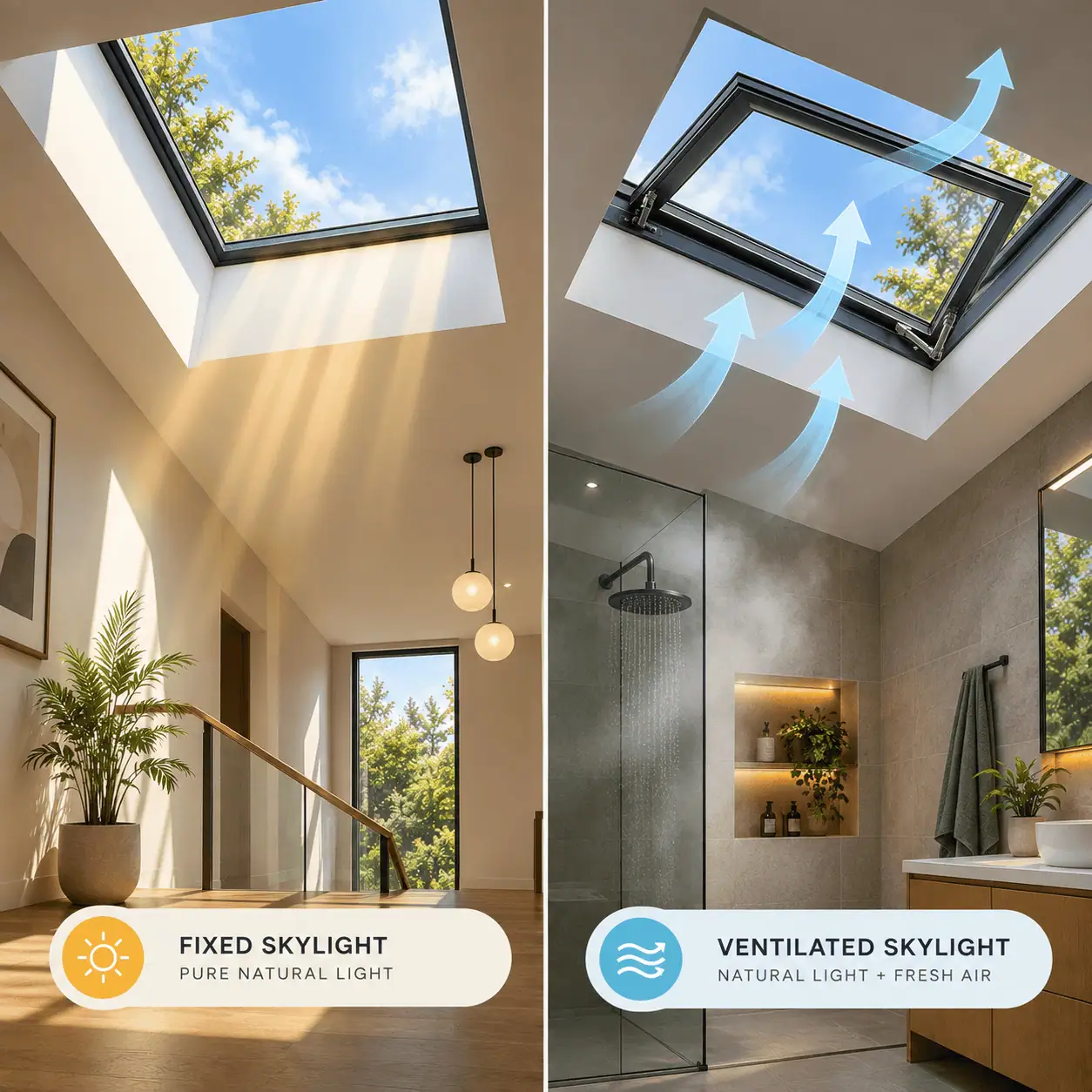
A fixed skylight is designed primarily to bring natural light into a space, while a ventilated skylight can also be opened to allow fresh air to circulate.
The right choice depends on the room, your ventilation requirements, the roof design, and how you plan to use the space.
What Is a Fixed Skylight?
As the name suggests, a fixed skylight remains closed and does not open.
Its primary purpose is to bring natural daylight into the room while maintaining a sealed connection between the interior and exterior.
Fixed skylights are particularly useful when your main objective is to brighten a space that feels dark or enclosed.
They can work well in:
- Living rooms
- Staircases
- Hallways
- Bedrooms
- Interior areas with limited windows
- High-ceiling spaces
Because there are fewer moving components, fixed skylights can also offer a relatively simple and low-maintenance solution.
If ventilation is already adequate through windows, doors, or other openings, a fixed skylight may provide everything you need.
What Is a Ventilated Skylight?
A ventilated skylight can be opened to allow air to move through the space.
Depending on the system, it may be manually operated or powered using an electric control system.
This makes ventilated skylights particularly useful in rooms where heat, humidity, or stale air can become an issue.
They can be especially practical in:
- Kitchens
- Bathrooms
- High-ceiling rooms
- Attics or loft-style spaces
- Rooms that tend to become warm
- Areas where additional airflow is desirable
Because warm air naturally rises, opening a skylight at a higher level can help release accumulated warm air and encourage air movement through the room.
Fixed vs Ventilated Skylights: The Main Difference
The simplest way to understand the difference is this:
Fixed skylight = daylight
Ventilated skylight = daylight + additional airflow
That doesn’t mean a fixed skylight cannot improve the comfort of a room. Bringing in natural daylight can completely change how a space feels.
However, if you also want to actively improve ventilation, a ventilated system provides an additional function.
Which One Provides Better Natural Light?
Both can provide excellent natural lighting.
The amount of daylight you receive depends more on factors such as:
- Skylight size
- Glass specification
- Roof position
- Orientation
- Room dimensions
- Surrounding structures
The opening mechanism itself does not necessarily determine how much light enters.
A well-designed fixed skylight can provide just as much daylight as a comparable ventilated skylight.
So if daylight is your only priority, there may be no need to choose an opening system simply for that reason.
Which One Is Better for Ventilation?
This is where ventilated skylights have a clear functional advantage.
A fixed skylight remains sealed, so it cannot be used as an opening for fresh air.
A ventilated skylight can be opened when needed, allowing warm indoor air to escape and fresh outdoor air to enter through the ventilation path.
This can be particularly useful in kitchens and bathrooms, where heat, moisture, and odours can build up.
In a suitable room layout, a ventilated skylight can also work alongside lower-level windows or doors to encourage natural airflow.
What About Heat?
Heat management is important for both types.
A common misconception is that simply choosing a ventilated skylight automatically solves heat problems.
It doesn’t.
The glass, size, location, shading, and overall design all influence how much solar heat enters the room.
Energy-efficient glazing and appropriate solar-control solutions can help balance natural daylight with indoor comfort.
A ventilated skylight can provide the additional benefit of releasing warm air when opened, but glazing selection remains important.
This is especially relevant in homes exposed to strong sunlight for several hours during the day.
Which One Requires More Maintenance?
A fixed skylight generally has a simpler design because it does not need opening mechanisms.
There are fewer moving components to maintain, although the glass, frame, seals, and drainage areas still need periodic inspection and cleaning.
Ventilated skylights have additional components such as hinges, opening mechanisms, handles, motors, or control systems depending on the design.
These components require appropriate maintenance to ensure smooth operation over time.
That doesn’t mean ventilated skylights are difficult to maintain. It simply means there are more components involved.
Which One Is Better for a Bathroom or Kitchen?
For rooms where moisture and heat are common, ventilation can be particularly valuable.
A ventilated skylight can help release warm or humid air, especially when combined with other ventilation openings.
For example, a bathroom with limited wall windows may benefit from a ventilated skylight that allows humid air to escape.
Similarly, a kitchen can benefit from additional airflow when cooking generates heat and moisture.
However, the suitability depends on the room layout and the overall ventilation strategy.
Which One Is Better for a Living Room?
For a living room, the choice depends on what you want the skylight to achieve.
If the room already has sufficient ventilation through windows and doors, a fixed skylight may be a practical way to introduce additional daylight.
If the room becomes warm or lacks adequate airflow, a ventilated skylight could provide an additional ventilation option.
The architectural design of the room should ultimately determine the choice.
Fixed or Ventilated: Which Should You Choose?
Here’s a simple way to think about it.
Choose a fixed skylight if:
- Your main priority is natural light
- The room already has adequate ventilation
- You prefer a simpler system
- You want minimal moving components
- The skylight is mainly being used as a daylight source
Consider a ventilated skylight if:
- Additional airflow is important
- The room becomes warm or humid
- You want to release warm air from higher areas
- The space has limited ventilation
- You want daylight and ventilation from the same roof opening
There is no universal answer. The best choice depends on how the room is designed and what you want the skylight to accomplish.
Don't Forget the Installation
Whichever type you choose, installation quality is just as important as the skylight itself.
A properly installed skylight should have appropriate attention to:
- Waterproofing
- Flashing
- Sealing
- Insulation
- Structural integration
- Drainage
- Glass specification
Poor installation can lead to water leakage, air gaps, condensation, and long-term performance issues.
This is why skylight selection and installation should be treated as one complete project rather than two separate decisions.
Bring More Light Into Your Home
Whether you choose a fixed or ventilated skylight, the goal should be the same: create a brighter, more comfortable space that makes better use of natural daylight.
At UrbanSkylight, skylight solutions can be planned around your home’s architecture, lighting requirements, ventilation needs, and overall design.
Explore our skylight solutions and discover how natural light can transform your space.
Final Thoughts
Fixed and ventilated skylights both have an important place in modern home design.
A fixed skylight is a straightforward solution when natural light is the main goal. A ventilated skylight adds another layer of functionality by allowing airflow when required.
Instead of asking which one is universally better, consider what your room actually needs.
If you need light, start with a fixed skylight. If you need light plus additional ventilation, a ventilated skylight may be worth considering.
The right choice can turn an ordinary ceiling into one of the most useful features of your home.